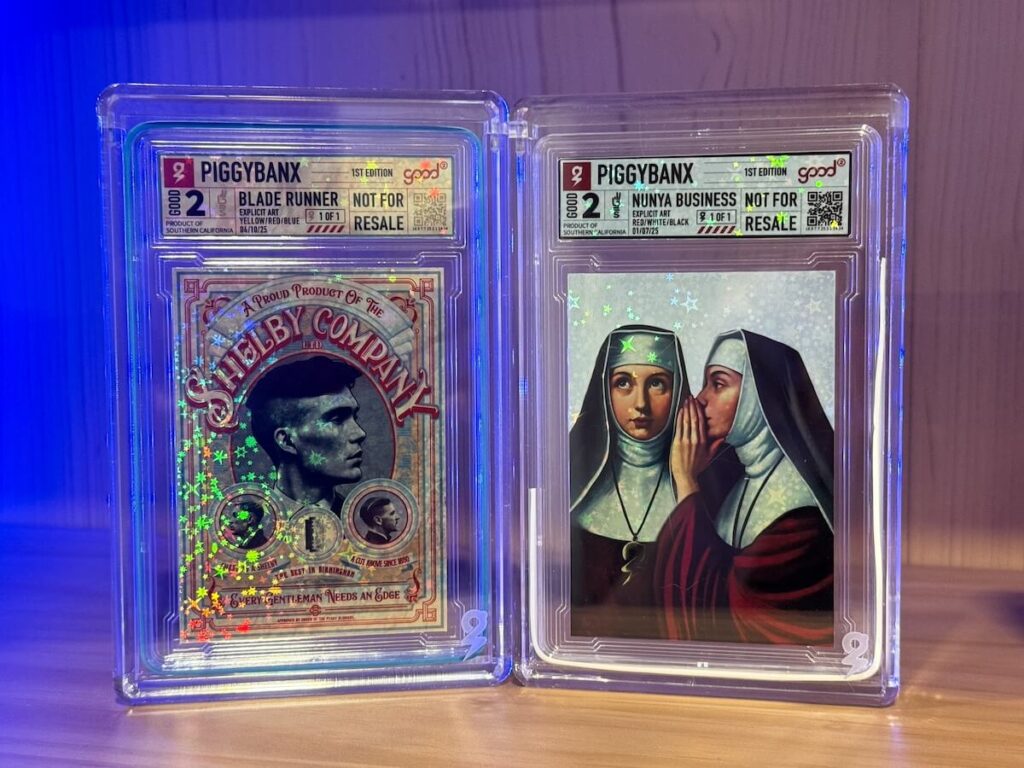
Spotlight on PiggyBanx: The “GOAT” Studio of the Fine Art Card Movement

Table of Contents

Introduction: When Cardboard Becomes Culture

In an industry that lives at the intersection of nostalgia, fine art, and street culture, PiggyBanx stands apart. To many collectors, it isn’t just a brand; it’s the holy grail, a studio whose drops feel like events, whose pieces read like artifacts, and whose community is as devoted as any in the wider art world. PiggyBanx has transformed the artist trading card from a clever novelty into a credible medium of contemporary art and an ecosystem with its own rituals, language, and lore.

Ethos: Craft, Concept, and Cultural Weight

What makes PiggyBanx different is not only the look, but also the point of view. Each release carries a layered concept, often fusing social commentary, pop-culture memory, and tactile design choices that go beyond superficial “fan service.” The studio’s ethos centers on meaningful materiality: textures, finishes, and dimensional elements are chosen to say something, not merely to shine under a sleeve.

Collectors talk about PiggyBanx is similar to the way museumgoers talk about new exhibitions, anticipating thematic through-lines, decoding symbolism, and trading impressions of how a piece “lands” months or years later. In other words, PiggyBanx has built not just a catalog but a canon.

The Visual & Material Language

PiggyBanx pieces feel unmistakable: visually bold, tactile, and meticulously finished, often with details that reward slow looking.

  • Layered Storytelling: Beyond portraiture or iconography, PiggyBanx cards fold in metaphors, textual fragments, and graphic cues that build a narrative.
  • Premium Finishes: Foil, embossing, spot gloss, etched elements, and mixed-media touches are not afterthoughts, they’re structural to the concept.
  • Tactile Memory: The studio treats cardboard like a gallery space. Cards frequently feel “built,” not merely printed.


This commitment to craft is why collectors describe PiggyBanx pieces as artworks small in scale, enormous in presence. However for those lucky enough, they do offer 400x and 1000x size artwork.

Scarcity and the Architecture of Desire

PiggyBanx mastered a balance: scarcity with substance. Limited edition, 1/1s, variant layers, and carefully curated series establish a cadence that breeds desire without feeling cynical. The scarcity isn’t a gimmick; it acts as a curatorial filter ensuring each release bears the weight to justify its limited supply.

That design of desire creates something vital: long-tail value. PiggyBanx pieces often remain conversation drivers long after the drop. The studio’s catalog feels more like chapters of an ongoing book than a parade of disconnected cards.

Community: The Engine Behind the Myth

The “holy grail” status doesn’t materialize from design alone, it’s also because of the community. PiggyBanx collectors are more like docents than flippers; they analyze themes, share care tips, trade with intention, and welcome newcomers with context. That shared literacy compounds the art’s impact: knowing why a particular PiggyBanx piece matters becomes part of owning it.

This community energy changes how value is perceived. Value isn’t only a market figure; it’s cultural equity, the piece’s role in shaping what art cards can be. PiggyBanx has cultivated a collector base that appreciates both.

Case Study: “Change” as a Material and a Message

One work that captures the PiggyBanx sensibility is the Gandhi portrait made from coins, a literal embodiment of the word “change,” honoring a figure who transformed the course of a nation. Material and message become inseparable: coinage (everyday currency) is arranged to form a leader whose legacy redefines what “value” means. It’s signature PiggyBanx: the medium is a metaphor, and the metaphor is a mirror.

Pieces like this are why the studio commands reverence. PiggyBanx doesn’t only illustrate icons; it reinterprets them, asking the collector to engage with form, history, and meaning simultaneously.

How PiggyBanx Shaped the Modern Art-Card Playbook

The broader art-card ecosystem: studios, solo artists, and collector platforms has absorbed several PiggyBanx hallmarks:

  1. Concept-First Releases: A thesis behind each drop.
  2. Museum-Grade Production: Elevated techniques typically reserved for prints, books, or gallery objects, condensed to card scale.
  3. Narrative Series: Drops that read as chapters, building continuity and collector commitment.
  4. Certificates of Authenticity: Clear edition labeling and authentication, raising confidence in long-term collecting.
  5. Cultural Dialogue: Pieces that converse with current events or art history rather than resting on nostalgia alone.


By treating art cards as a legitimate format for contemporary art, PiggyBanx effectively raised the ceiling for the entire category.

Collecting PiggyBanx: Strategy, Care, and Long-Term Thinking

If you’re building a PiggyBanx focus within your collection, consider a framework that respects both art and market:

  • Theme Cohesion: Curate around an idea (e.g., social change, portraiture, money & value, or urban iconography). Coherent sub-collections tend to age well, culturally and financially.
  • Edition Discipline: Track edition sizes, variants, and 1/1s. Limited editions are the backbone of grail collecting; know your hierarchy.
  • Condition & Preservation: High-end finishes deserve high-end protection. Avoid harsh light; consider leaving in the archival boxes and hang directly on your walls. The artwork is not meant to be cracked and graded.
  • Provenance Packets: Save COAs, release cards, and any original studio packaging. PiggyBanx’s “full experience” often extends beyond the card, as complete sets of ephemera can add intangible and market value.
  • Patience and Timing: PiggyBanx pieces can generate immediate heat, but long-tail holds often tell the truer story. Let the culture catch up to the concept.

Market Dynamics: Beyond Comps

With PiggyBanx, simple comparables don’t always tell the truth. One card’s price can be shaped by symbolic gravity as much as by supply. A piece that ignites discourse (or becomes a reference point for future releases) can punch well above typical “comp logic.” That’s why experienced collectors track cultural signals: mentions, essays, exhibition crossovers, and the studio’s own narrative arcs, alongside sales data.

Why PiggyBanx Is the “Holy Grail”

Three pillars support the grail reputation:

  1. Ideas With Teeth: Ambition in concept works that say something new.
  2. Craft With Intent: Production choices that deepen the message, not just decorate it.
  3. Community With Memory: A collector base that documents, educates, and preserves the story behind each piece.


PiggyBanx proves that when a studio unites these three, the result transcends hype. We get art that lasts.

What’s Next: The Future of PiggyBanx (and the Format Itself)

If the trajectory holds, expect deeper cross-format experimentation with hybrid objects, sculptural elements, or book-as-card releases. Collaborations with institutions, musicians, or fashion houses feel inevitable: PiggyBanx’s language translates elegantly across mediums. And as more curators and critics engage with art cards, we’ll likely see PiggyBanx pieces in exhibition contexts where their conceptual backbone can be fully unpacked.

For collectors, this means early PiggyBanx works may accrue fresh layers of significance. For the scene, it signals a maturing phase where art cards are discussed in the same breath as prints, zines, or multiples, serious art forms with serious discourse.

Closing: Building Your PiggyBanx Chapter

Whether you’re aiming for a single centerpiece or an entire PiggyBanx wing, collect with intention. Learn the narratives, preserve the ephemera, and craft a viewpoint that reflects who you are as a steward of this culture. PiggyBanx has already given us a framework for what art cards can be; now it’s on the community to build a record that does the work justice.

If “grail” means the rare object we quest for because it changes the way we see, then PiggyBanx has earned the title. Not because the cards are scarce, though they are, but because they reframe value, memory, and meaning on a canvas the size of your palm.

Shea Winter Roggio