Who is Takashi Murakami: The Superflat Pioneer Who Bridged High Art and Pop Culture

Table of Contents

Introduction

Few contemporary artists have blurred the lines between fine art and pop culture as boldly as Takashi Murakami. Called the Warhol of Japan and celebrated for his instantly recognizable “Superflat” style, Murakami is more than just a painter; he’s a global cultural force. From adorning Louis Vuitton handbags with smiling flowers to designing album covers for Kanye West, he’s proven that art can thrive at the crossroads of tradition and modernity, luxury and street culture, highbrow and lowbrow.

In fact, his cultural impact was cemented when TIME Magazine named him one of the 100 most influential people in the world. Notably, he was the only visual artist included that year. Murakami has consistently refused to accept the boundaries placed in front of him, redefining what it means to be an artist in the 21st century.

This is the story of how Murakami transformed his love of anime, manga, and Japanese tradition into a global empire of art, fashion, and collectibles.

Early Life: From Anime Dreams to Artistic Discipline

Murakami was born in Tokyo in 1962. At an early age he was fascinated by the colorful, fantastical worlds of anime and manga. Unlike many who admired those media as fleeting entertainment, Murakami wanted to create them. His dream was to work in the animation industry, drawing inspiration from the stylized exaggeration, whimsy, and storytelling of Japanese comics.

To pursue this dream Murakami enrolled at the Tokyo University of the Arts, one of the most prestigious art institutions in Japan. There, he immersed himself in the study of Nihonga, a traditional Japanese painting style rooted in centuries of practice. He eventually went so far as to earn a Ph.D. in Nihonga painting, mastering classical techniques that demanded rigor, patience, and a reverence for history.

But as disciplined as the practice was, Murakami quickly began to feel constrained by it. The high art world in Japan was deeply political and hierarchical, and to him, it felt stagnant. Worse, he believed that contemporary Japanese art was little more than a shallow imitation of Western trends, lacking its own identity. Murakami yearned for something more, something that reflected Japan’s true cultural soul.


Breaking Away: Dissatisfaction and Experimentation

Murakami’s disillusionment with Japanese contemporary art became a turning point. Instead of conforming, he began to carve out his own space, experimenting with art that was satirical, provocative, and distinctly Japanese in voice.

In the early 1990s, his boldness was not immediately embraced at home. Many in Japan saw his playful, cartoonish approach as unserious or frivolous. Some recognized his talent, and in 1994, Murakami was awarded a fellowship from the Asian Cultural Council, giving him the chance to live and work in New York City.

That year abroad was transformative. In New York, he found himself immersed in a different art world, one more receptive to subversion and humor. Western audiences immediately connected with his aesthetic, drawn to its mix of childlike whimsy and biting critique. For Murakami, the experience confirmed that his instincts were right: art didn’t have to mimic Western modernism to be taken seriously.

The Birth of “Superflat”

It was during this period that Murakami developed his defining philosophy: Superflat. The term describes both a visual style and a cultural critique.

Visually, Superflat art emphasizes flat planes of color, two-dimensional surfaces, and bold outlines, echoing anime, manga, and ukiyo-e woodblock prints. Philosophically, it speaks to the “flattening” of distinctions between high art and low culture. In Murakami’s world, a smiling flower on a luxury handbag carries the same artistic weight as a gallery canvas.

Superflat was also Murakami’s response to postwar Japanese culture, a time when consumerism, media saturation, and fantasy worlds (otaku subculture) created a unique visual language. By naming and defining it, Murakami not only built a brand but gave voice to an entire generation of Japanese creativity.

Building an Empire: From Factory to Global Collaborations

Like Warhol before him, Murakami understood the power of scale. He didn’t want to be a solitary painter producing one canvas at a time; he wanted to create a system that could keep up with global demand.

He established his own production workshop, Kaikai Kiki Co. Ltd in Japan (2001), which functions both as a factory for his large-scale projects and a talent incubator for emerging Japanese artists. This model allowed him to move quickly, expand his reach, and foster new voices within his orbit.

Murakami’s collaborations read like a who’s who of cultural icons:

  • Louis Vuitton: His 2003 partnership with Marc Jacobs transformed luxury fashion, bringing rainbow-colored monograms and smiling daisies to handbags. These designs became instant status symbols.
  • Kanye West: Murakami designed the cover for West’s 2007 album Graduation, creating one of hip-hop’s most recognizable visuals.
  • Virgil Abloh: The late Off-White founder and Murakami collaborated on multiple projects, blending streetwear and art in new ways.
  • Kid Cudi, Pharrell Williams, Billie Eilish: Musicians across genres have drawn inspiration from Murakami’s aesthetic, working with him on visuals, videos, and merchandise.
  • Fashion & Streetwear: Beyond Vuitton, Murakami has partnered with Uniqlo, Supreme, Issey Miyake, and more, embedding his imagery in every corner of culture.

What was once dismissed as “cartoonish” had become luxury, collectible, and deeply influential.

Cultural Critique Hidden in Playfulness

At first glance, Murakami’s art can seem innocent: smiling flowers, wide-eyed characters, candy-colored explosions of joy. But beneath the surface lies social commentary.

Many of his works touch on themes of consumerism, postwar trauma, and Japan’s obsession with cuteness (kawaii). His recurring motifs often parody both Western pop icons and Japan’s own cultural contradictions: skulls, mushrooms, and Mr. DOB (a chaotic Mickey Mouse-like figure), for example.

By packaging critique inside playful aesthetics, Murakami ensures accessibility while inviting deeper reflection. He has said that he wants his art to resonate with people whether viewed in a gallery, a department store, or on Instagram.

Murakami and Collectibles: Cards, Prints, and Beyond

For the Cardboard Junkie community, Murakami holds a special place because he’s one of the few fine artists whose work naturally translates into collectibles.

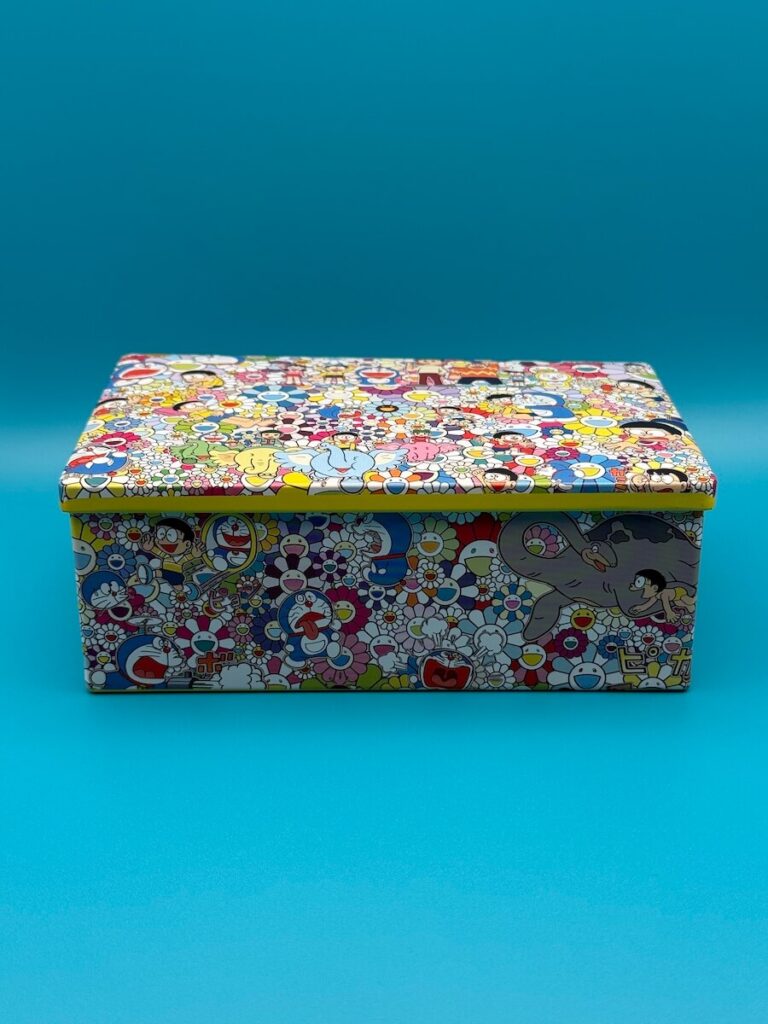
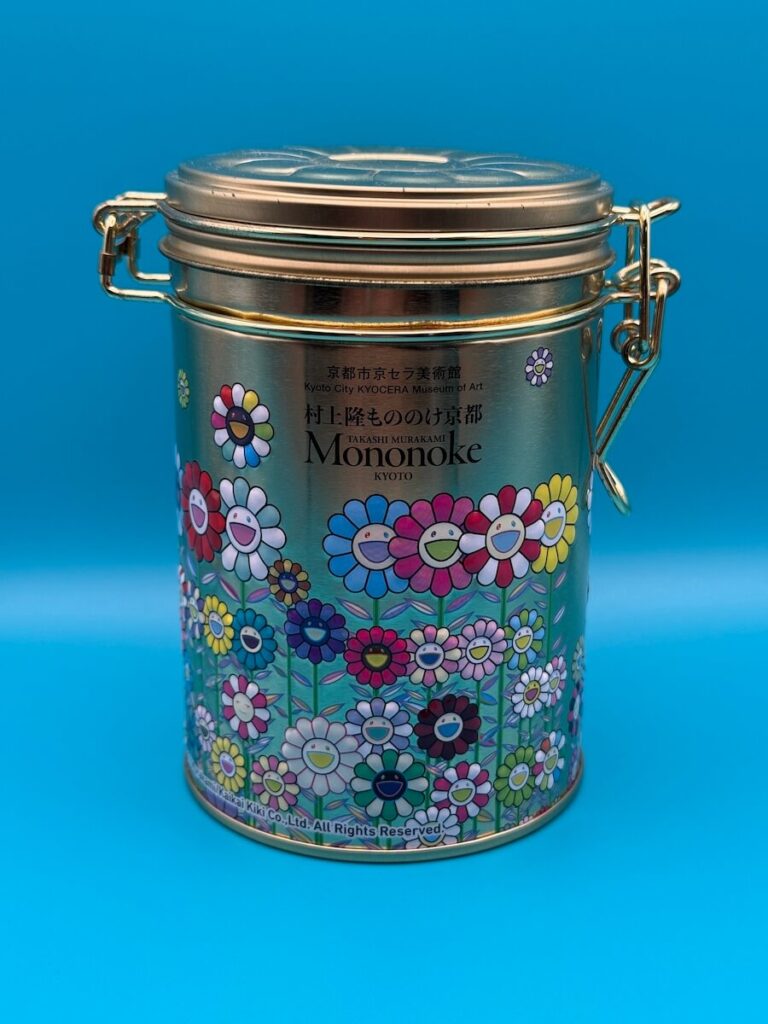
  • Limited Edition Prints & Figures: Murakami regularly releases limited runs that sell out instantly, making them prized on the secondary market.
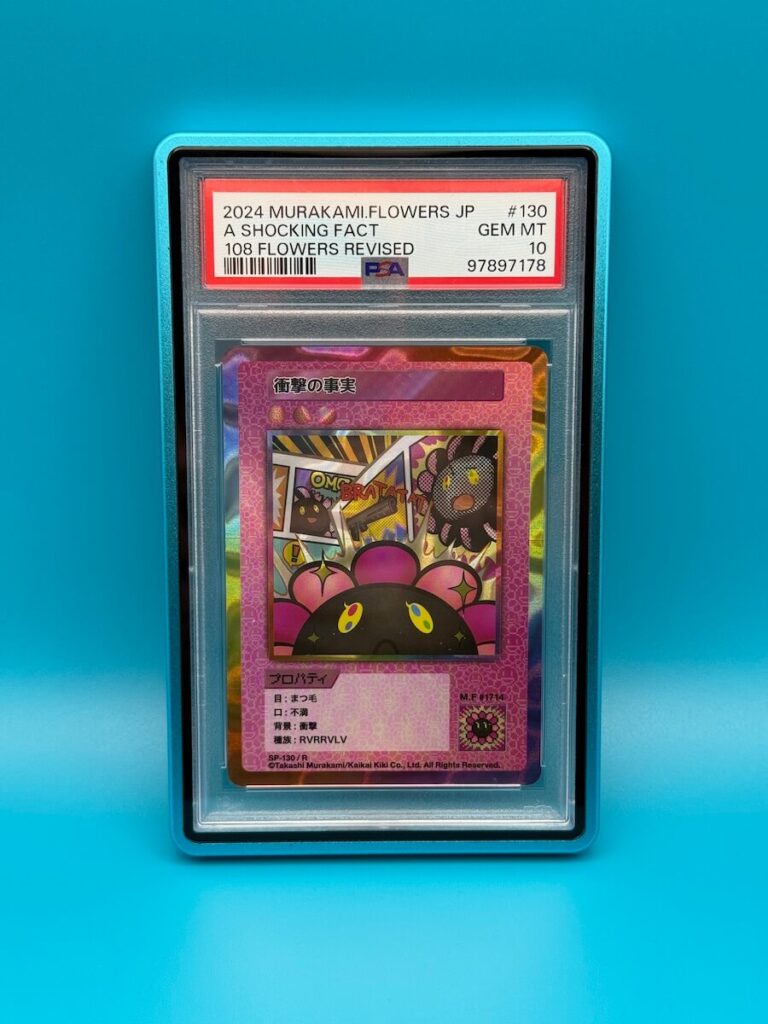
  • Art Cards: His work has entered the world of collectible cards, blending fine art with trading card culture in a way that excites both seasoned collectors and newcomers.
  • Cross-Market Appeal: Murakami’s collaborations make his imagery accessible at multiple price points, from $10 Uniqlo tees to six-figure gallery pieces.

In this sense, he mirrors the very mission of Cardboard Junkie: democratizing art collecting, breaking down barriers, and educating new collectors about how high art and popular culture intersect.

Legacy: Redefining the Status Quo

Murakami’s career is a lesson in never settling for the status quo. What began as dissatisfaction with Japan’s imitation of Western art turned into a global redefinition of what art can be. He took what was considered “low culture” – anime, manga, kawaii imagery- and elevated it into the halls of museums and luxury houses.

By doing so, he not only transformed his own career but also shifted how the world perceives Japanese culture. His smiling flowers are now as synonymous with Japan as Hokusai’s Great Wave or traditional kimonos.

Perhaps most importantly, Murakami represents the possibility of reinvention. He started with limits, the rigidity of Nihonga, the skepticism of Japanese critics, the dismissal of cartoonish aesthetics, and turned them into stepping stones. Today, he stands as one of the greatest and most influential artists of recent history.

Conclusion

Takashi Murakami is more than a painter. He’s a cultural architect, a businessman, a philosopher, and a bridge between worlds. His “Superflat” vision collapsed the hierarchy between fine art and consumer goods, showing that beauty and meaning can exist everywhere, in a museum, on a t-shirt, or in a trading card.

For collectors, Murakami is a reminder that art doesn’t have to be distant or exclusive. It can be playful, accessible, and deeply tied to the cultural moment. Whether you’re chasing a limited-edition print, a collaboration sneaker, or a rare art card, owning a piece of Murakami’s world means participating in a living, evolving story of creativity.

And that, at its core, is what makes him a perfect subject for the Cardboard Junkie spotlight.

Shea Winter Roggio